

How To Books On Cleaning And Filleting Fish
Freshwater and Saltwater provide a bounty of fish that are groovy for eating. In order to eat your fish, yous need to larn how to clean your fish. Common white meat species like Walleye and Perch simply require you to know how to fillet a fish. Notwithstanding, agreement how to gut a fish and how to scale a fish allows you lot to preserve your catch longer and correctly prepare Salmonid species. Here is a break downwardly of the tools and procedures for how to clean fish in training for the table.
How to Make clean a Fish: Preparation
In social club to properly clean and procedure your catch, you demand access to a few essentials. Fish cleaning requires a abrupt pocketknife, a cut board, a bowl, a trash bag, and a fresh source of water. Discarded scraps and carcasses go in the trash handbag, your fresh fillet'south go into the make clean bowl . If you aren't cooking your catch right abroad, it should be kept cool on ice or in a refrigerator until you are ready to ready it. Recollect to continue your fish alive in a live-well or stringer until it is time to fillet your take hold of. If you are unable to keep your fish live, or you are fishing for Trout or Salmon, make sure to gut your fish right after yous catch it and store it in a cooler.
How to Gut a Fish
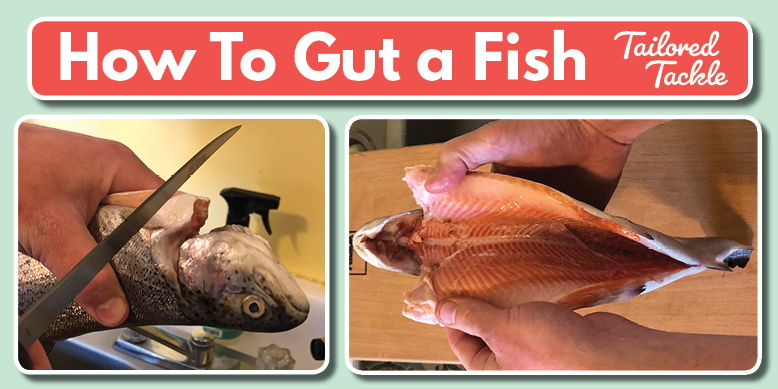
If keeping your fish fresh and cool is not an option you'll need to gut the fish on the h2o. Gutting maintains freshness and prevents the claret and organs from contaminating the meat.
Step 1. Rinse fish in cold h2o and wipe downwards slime and debris
Stride 2. Cut the gill abroad from the jaw to bleed the fish out
Step three. Lay the fish with the stomach facing toward you and insert the tip of the knife into the anus.
Step 4. Cut the underbelly of the fish in a straight line from the anus to the gills.
Step 5. Grab the gills and pull outwards to remove the insides
Stride 6. Rub confronting the sides and rinse to remove anything leftover
If your fish is a Salmonid (Trout or Salmon) it is important to remove the blood sack from forth the courage, otherwise it will bleed into the meat. Remove the bloodline after you gut the fish by pressing a spoon our your thumb confronting the inside of the spine. Work the blood sack back and along until the blood has drained completely. This step is non necessary for white meat fish like Perch and Walleye.
How to Scale a Fish (Scaling is Optional)
If yous adopt to consume your fish with the peel on, y'all will need to remove the scales. The pare can provide a more than robust flavor and is preferably left on when smoking or roasting a fish whole. Utilise the back edge of your knife to scrape the scales off, working from tail to head. After roughly 90% of the scales are removed, rinse and wipe down whatever loose scales stuck to the pare. Smoking and roasting are more advanced methods of preparation. For your typical skinless fillet, you lot can skip scaling your fish.

How to Fillet a Fish
The almost common way to process your fish is to fillet it. Filleting a fish means to remove two large pieces of boneless meat from each side of the fish. This is the ideal method for beginners learning how to clean a fish.
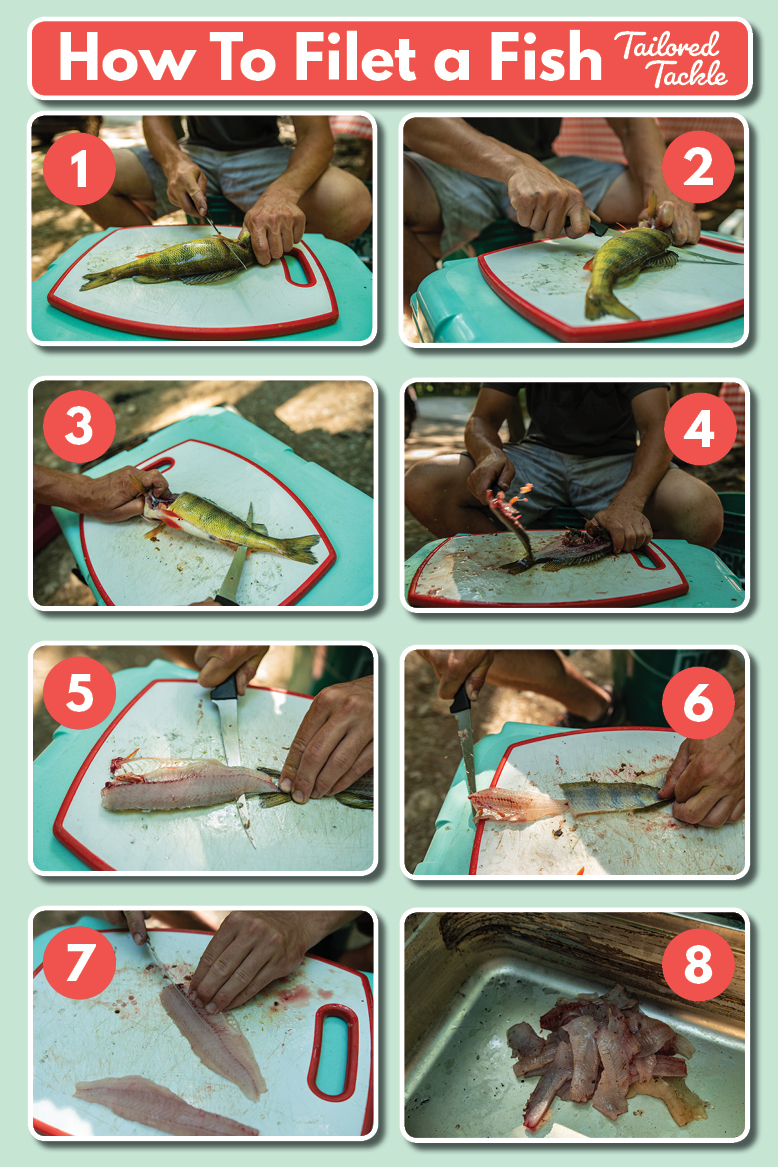
Step 1. Lay the fish on the cutting lath and m ake a cut behind the gills and the pectoral fin until you reach the courage.
Step 2. Turn your knife toward the tail so information technology lays flat against the backbone.
Step 3. Cut along the backbone through the ribs and abdomen until you are roughly 1/4″ from the tail.
Step 4. Flip the slab over and so that the skin side of the fillet is laying on the cut board.
Step v. Slant your knife to a 45° angle near the base of the tail, drawing your knife back and forth until you are underneath the meat
Step half-dozen. Lay your knife flat and work information technology back and forth against the grain of the pare to divide the skin from the fillet
Step 7. To hands remove the rib basic, cut out the semi-circumvolve outline by the belly of the fish.
Step 8. Rinse your fillets with cold water.
Step 7 is the virtually efficient way to completely remove the rib bones. Alternatively, you tin separate the rib bones from the belly by working the blade underneath the rib-cage from the lateral line of the meat down through the dorsal. This method is more advanced and easily botched. A beginner will typically leave more basic on in comparison to meat harvested so we recommend to simply cut out the rib-cage entirely.
Storing your Fillet
If you aren't eating your catch right away, you should store your fillet past freezing information technology. When freezing your fillets, it is important to remove air from the storage compartment. Trapped air can cause loss of flavor and tarnish the flakiness of the fillet. Information technology is also important to rinse your fillets with cold h2o and dry out with a paper towel or cloth before storing your fillet. Otherwise leftover insides can contaminate the meat and negatively affect flavor. At present that your fillets are squeaky clean you lot tin prep them for freezer storage.
Freezing your Fillet
The iii most common ways to store fillets for freezing are wrapping, freezer bagging and vacuum sealing. Wrapping the fillet is the virtually traditional method. First, wrap the meat with plastic wrap or tin foil and then wrap a layer of freezer paper around it. This method is best for compacting your fillet in tight storage. Freezer bagging your fillet is the nearly user-friendly. Simply zip them up on their ain or submerge them in water within the handbag to lock out equally much air as possible. Vacuum sealing your fillet is the most effective pick. Using vacuum locked bags or a processor, you can virtually remove all air and compress your fillets into tight packaging. However, vacuum sealing is requires boosted equipment and know-how. Simply freezer bagging your showtime fillet will practice the pull a fast one on.
Prepping Your Fillet for Cooking
Later on y'all've processed and stored your catch, you'll eventually want to cook it. Thaw out your meat by placing the packaging in a basin of water at room temperature. This thawing method typically takes 30 min to an hr. You can utilize quicker defrosting methods, however you run the risk of cooking your meat prematurely. One time thawed, wash your filet nether a faucet. Cheque your fillets for any bones missed by gently rubbing the meat nether the running water. Once the basic are totally gone, pat downwards your fillet with a newspaper towel so it is dry and ready to cook. Some common styles of cooking fish are frying, baking, and smoking fish.
If You Know How to Fillet a Perch, Yous Know How to Make clean a Fish
A Perch was used to demonstrate how to fillet your fish. The same steps for filleting your Perch tin can be used to fillet near of the popular species in Freshwater & Saltwater. The gutting and scaling methods in this article were shown on a Trout. However, these gutting and scaling steps can be duplicated on whatever fish species. Fish with more complex os structures such every bit Pike and Catfish require a few more steps to get an platonic fillet. We will comprehend more than avant-garde methods for cleaning complex fish in a future post.

Source: https://tailoredtackle.com/how-to-clean-a-fish-gut-a-fish-fillet-a-fish/
Posted by: jenkinshuden1962.blogspot.com
0 Response to "How To Books On Cleaning And Filleting Fish"
Post a Comment